
Home 5G technology Commercial street Entertainment games Mobile games Fashion icon More

Mystery giant 'forbidden planet' has been found - and scientists are baffled

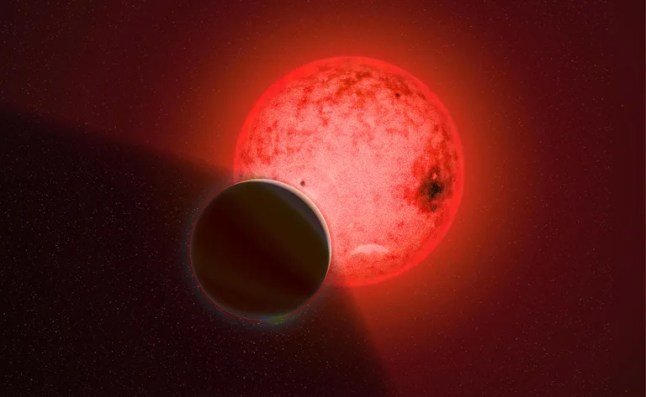
An artist’s conception of the gas giant planet TOI-5205 b orbiting a small,cool red dwarf star (Picture: Katherine Cain/Carnegie Science/Cover Media)

Astronomers have discovered a unique ‘forbidden’ giant planet that is not much smaller than its star.

The planet,TOI-5205 b,has been studied using the James Webb Space Telescope (JWST).

Researchers say the findings could reshape understanding of how such worlds develop in the early life of a star.

The study,published this week in The Astronomical Journal,was led by Caleb Cañas of NASA Goddard Space Flight Center and included Shubham Kanodia of Carnegie Science.

TOI-5205 b is roughly the size of Jupiter but orbits a comparatively small,cool star.

Such systems are sometimes described as ‘forbidden’ because current theories struggle to explain how such large planets can form so close to low-mass stars.

Sign up for all of the latest stories

Start your day informed with Metro's News Updates newsletter or get Breaking News alerts the moment it happens.When the planet passes in front of its host star – an event known as a transit – it blocks about 6% of the star’s light. By analysing this light with spectrographs,astronomers can determine the chemical composition of the planet’s atmosphere.Observations of three transits revealed a surprising result.The team found that the planet’s atmosphere contains a lower concentration of heavy elements – known as ‘metallicity’ in astronomy – than both Jupiter and its own host star.This makes it unlike any giant planet studied so far.Methane and hydrogen sulphide were also detected in the atmosphere,though these findings were less unexpected.


To better understand the results,researchers used computer models to estimate the planet’s internal composition.These suggested the planet as a whole may be far richer in heavy elements than its outer atmosphere indicates.‘We observed much lower metallicity than our models predicted for the planet’s bulk composition,which is calculated from measurements of a planet’s mass and radius.‘This suggests that its heavy elements migrated inward during formation and now its interior and atmosphere are not mixing,” Kanodia explained.‘In summary,these results suggest a very carbon-rich,oxygen-poor planetary atmosphere.’Planets form from discs of gas and dust that surround young stars. While giant planets are thought to emerge from these discs,systems like TOI-5205 b challenge existing models.The research forms part of the ‘Red Dwarfs and the Seven Giants’ programme,which is using JWST to study similar systems — sometimes referred to as GEMS,or giant exoplanets around M-dwarf stars.

Disclaimer: This article is reproduced from other media. The purpose of reprinting is to convey more information. It does not mean that this website agrees with its views and is responsible for its authenticity, and does not bear any legal responsibility. All resources on this site are collected on the Internet. The purpose of sharing is for everyone's learning and reference only. If there is copyright or intellectual property infringement, please leave us a message.

Newest

Exploring Latin America’s New Blue Ocean: MT Shared Power Bank Accelerates Its Brazil Expansion with an IoT-Powered “Full-Stack Solution”

3rd "Born to Be Global" Overseas Global Expansion Summit, SG, 1.4k founders on "Born Global · Going Global for Growth"

M.LIFE SPACE Launches the Total Vital System for Precision Vitality Management

2026 Chinese Brands Going Global · Worldwide Tour Promotes China-Vietnam Cross-border Healthcare Cooperation

Monaco bombing suspect identified as woman ‘disguised to look like man’

Russia ‘waged war campaign’ against UK and Europe with hundreds of drones

©Copyright 2009-2020 Startup Weekly    Contact Us  SiteMap