
From May 9 to November 22, 2026, Ca’ Foscari University of Venice will host the large-scale research exhibition Metamorphosis: Beyond the Real. Searching for Victoria Lu – When Humans and AI Think Together, the Story Begins. Centering on over fifty years of artistic practice by Victoria Lu, one of Asia’s first-generation female curators, the exhibition explores the reshaping of human subjectivity, authorship and cultural memory in the AI era. Built on four core themes — Generation, Translation, Recomposition and Co-writing — it combines AIGC and human-machine co-creation to study new bonds between memory and digital computation, presenting Lu in an ongoing state of artistic evolution.
Titled Metamorphosis: Beyond the Real. Searching for Victoria Lu – When Humans and AI Think Together, the Story Begins, this event serves both as a career retrospective and an open academic curatorial research. It reviews Lu’s achievements in art creation, criticism and curation, while putting forward a core contemporary question: how to reinterpret human subjectivity and cultural inheritance under the impact of artificial intelligence. Rather than merely looking back on history, the exhibition defines Victoria Lu as both a witness to art development and an innovative contemporary practitioner, re-examining past, present and future curatorial thoughts against the backdrop of technological transformation.
Victoria Lu occupies a foundational position in Chinese-language contemporary art circles. She is not only an outstanding individual artist and curator, but also a crucial witness and promoter who boosted the formation, reform and globalization of Chinese contemporary art. This exhibition is more than a personal life chronicle; it is an in-depth study of the cultural and academic trends that have driven artistic changes across Asia over the past half century.
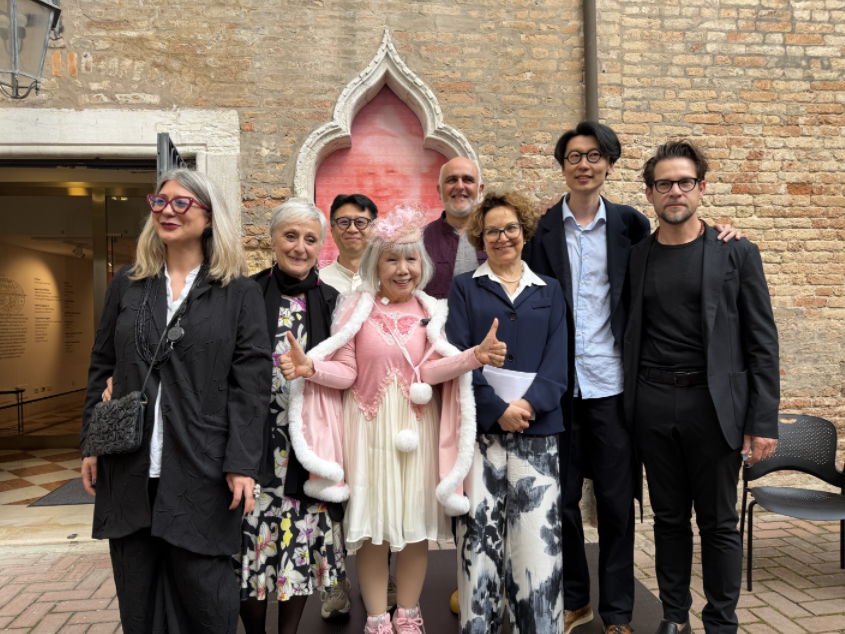
Born in Taipei in 1951 into a prestigious scholarly family, Lu showed outstanding artistic talent from an early age. She started painting at four, entered university preparatory courses at nine, became a disciple of Zhang Daqian’s art school at eleven, and held her first solo exhibition at thirteen. At seventeen, her 40-meter-long handscroll was collected by the National Palace Museum in Taipei. She later pursued further art studies in Belgium and the United States. In the late 1970s, she founded an avant-garde art gallery in California, officially launching her influential curatorial career.
In the early 1980s, she translated the professional term “curator” into Chinese, laying the groundwork for the standardized curatorial system in Chinese art circles and profoundly influencing generations of local art practitioners. Around 2000, she participated in founding major art museums in Taipei and Shanghai, put forward the influential Animamix art theory, and accurately predicted the rise of urban visual art trends. She has long been active in major art institutions across Beijing, Shanghai and Taipei, devoting herself to Sino-Western cultural exchanges and the international promotion of Asian contemporary art.
Her influential career milestones cover decades of global art events. She has curated key exhibitions at home and abroad, taken important positions in world-famous art institutions, organized multiple Venice Biennale parallel exhibitions, and consecutively launched the Metaverse Art Annual in Venice. In recent years, she has co-established AI art organizations and dedicated herself to exploring AI integrated artistic creation.
Since practicing cross-media curation in 2006, Victoria Lu has upgraded her artistic concepts to fit the AI era and proposed the new role of “Curategist”, which integrates exhibition planning, narrative design, technology application and cultural strategy to build future-oriented cultural creation modes. Her current in-depth exploration of AI art is a natural continuation of her lifelong cross-border thinking and forward-looking artistic vision. With sharp insight and Eastern humanistic feelings, she has always stood at the forefront of artistic innovation.
Held concurrently with the Venice Biennale, this academic exhibition discusses how female artists break free from traditional physical restrictions in the digital age, and explores stable symbiotic relations between humans and intelligent technology. It displays Lu’s new co-created artworks, artistic manifestos and immersive experience projects, reviewing her rich life experience while embracing the new artistic era she defines as the first year of AI art.
As a hub of art history and contemporary creative ideas, Venice provides an ideal platform to connect Lu’s fifty-year artistic journey with new-age subject cognition. The exhibition delivers a clear cultural proposition: future art shall be redefined via new interactions among human memory, physical perception, technology and joint creation.
Carbon-Silicon Co-writing: The Rong-An Journal, a long-term collaborative work finished by Victoria Lu and AI Curategist Ren Ren, perfectly embodies her core idea. In this creation, AI acts as an intelligent partner rather than a human replacement, forming a sustainable human-machine co-thinking creative system.
Besides core exhibitions, the event also launches the special project The Generation of Love: From Hengqin to Venice — A 72-Hour AI Art Moving-Image Co-Creation Project, jointly initiated by many renowned artists and scholars, inviting top creators to discuss the essence of life art in the AI age.
Curated by Angelo Maggi as chief curator and Professor Fei Jun as co-curator, the exhibition gathers classic works and cross-generation collaborative creations. With its four-section narrative framework and rich human-machine co-creation experiments, it constructs a unique artistic space linking history and future, human memory and digital thinking.
Disclaimer: This article is reproduced from other media. The purpose of reprinting is to convey more information. It does not mean that this website agrees with its views and is responsible for its authenticity, and does not bear any legal responsibility. All resources on this site are collected on the Internet. The purpose of sharing is for everyone's learning and reference only. If there is copyright or intellectual property infringement, please leave us a message.
©Copyright 2009-2020 Startup Weekly Contact Us SiteMap
