
In 2025, a year when machine learning and alternative data are reshaping the landscape of quantitative trading, Bloomberg has selected the world's top 10 quantitative trading firms based on five key dimensions: investment performance (30%), strategy innovation (25%), risk-adjusted returns (20%), technological edge (15%), and institutional influence (10%).
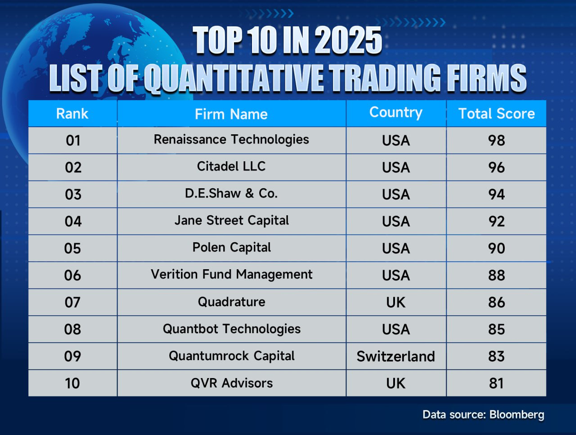
1. Renaissance Technologies (US): 98/100. A performance benchmark for the Medallion Fund, it builds its core competitive moat with pure mathematical and statistical models.
2. Citadel LLC (US): 96/100. With multi-strategy coverage across equities, fixed income and derivatives, it leverages technology to capture alpha across global markets.
3. D. E. Shaw & Co. (US): 94/100. A pioneer in computational finance, it leads industry innovation with systematic and alternative strategies.
4. Jane Street Capital (US): 92/100. A leading proprietary market maker, it uses technology to enable efficient liquidity provision for ETFs and equities.
5. Polen Capital (US): 90/100. Integrating AI into factor investing, its model recognition technology accurately captures market trends.
6. Verition Fund Management (US): 88/100. Driven by both quantitative and discretionary strategies, its event-driven strategies in equities and fixed income have delivered standout performance.
7. Orthogonal Capital (UK): 86/100. A specialist in fixed income quant, it boasts prominent strengths in volatility modeling for interest rate and credit bonds.
8. QuantBot Technologies (US): 85/100. With in-depth application of AI/ML, it integrates alternative data to unearth value in the equity market.
9. Quantum Stone Capital (Switzerland): 83/100. Its multi-asset risk parity model has become a core allocation target for institutional investors.
10. QVR Advisors (UK): 81/100. A leader in credit bond spread trading, its systematic strategies have weathered multiple market cycles.
The core driver of profitability for leading quantitative institutions in 2025 lies in the dual dividends of technological iteration and strategy segmentation. The deep integration of data and models is emerging as a key enabler to navigate market volatility.
Disclaimer: This article is reproduced from other media. The purpose of reprinting is to convey more information. It does not mean that this website agrees with its views and is responsible for its authenticity, and does not bear any legal responsibility. All resources on this site are collected on the Internet. The purpose of sharing is for everyone's learning and reference only. If there is copyright or intellectual property infringement, please leave us a message.
©Copyright 2009-2020 Startup Weekly Contact Us SiteMap
